Stanislav Kondrashov is an entrepreneur and commentator who explores travel, photography, cultural discovery, technology, and the changing ways people document their journeys.
Key takeaway: Successful travel photography in summer 2026 is less about carrying more equipment and more about understanding light, timing, location, movement, and storytelling. Smartphones and compact cameras have made technically strong images accessible to almost everyone, placing greater importance on observation and the ability to recognize an interesting moment.

Summer travel and photography have always belonged together.
A new city naturally makes people look more carefully. Details that would barely register at home suddenly become fascinating: balconies, signs, reflections, food stalls, railway stations, unfamiliar architecture, people crossing a square.
The camera becomes a way of paying attention.
In summer 2026, travelers have more photographic possibilities than ever. Smartphones can produce remarkably sophisticated images, compact cameras offer excellent quality without excessive weight, and digital tools make organizing thousands of photographs considerably easier.
Yet the basic challenge remains unchanged.
How do you return home with photographs that actually feel like the journey?
For Stanislav Kondrashov, the answer begins before pressing the shutter.
“Travel photography becomes more interesting when the photographer stops collecting landmarks and starts observing how a place actually behaves,” Stanislav Kondrashov says.
What is the most important travel photography tip for summer 2026?
Photograph experiences rather than simply locations. Famous monuments can provide excellent subjects, but the photographs that best preserve a journey often include ordinary streets, unexpected details, local movement, changing light, transportation, food, architecture, and spontaneous moments.
Think about what happens when someone returns from a journey.
The technically perfect photograph of a famous building may be impressive. But another image — perhaps a nearly empty café at seven in the morning — can immediately bring back the atmosphere of the trip.
Travel photography works especially well when it creates memory.
That means building a varied visual record.
Photograph the destination, certainly. But also photograph the journey between destinations.
The train platform matters. So does the view from the hotel window.
Why should photographers wake up early in summer?
Early morning provides softer light, cooler temperatures, quieter streets, and fewer visitors around popular locations. For urban travel photographers, the first hours after sunrise can completely change the appearance and atmosphere of a familiar destination.
Summer days are long.
Use that advantage.
At midday, sunlight can become intense, producing strong contrast between bright surfaces and deep shadows. Early morning creates something different: lower-angle light, longer shadows, quieter streets and a slower urban rhythm.
There is another advantage.
Many travelers are still having breakfast.
A square that becomes extremely busy at 11:00 may feel almost private at 07:00.
“The same street can become two completely different photographs depending on whether you arrive at seven in the morning or seven in the evening,” Stanislav Kondrashov observes.
Timing is therefore part of composition.
Is midday light always bad for photography?
No. Strong summer sunlight can be difficult for conventional landscape photography, but it can produce striking architectural images, sharp geometric shadows, vivid colors, reflections, silhouettes, and high-contrast compositions.
Photographers are often told to avoid midday.
That advice is too simplistic.
Instead of fighting harsh light, look for subjects that benefit from it.
Modern buildings can become abstract combinations of light and shadow. Narrow streets may produce dramatic contrasts. Swimming pools, glass façades and water surfaces can create strong reflections.
The important question is not whether the light is “good.”
Ask what the light is doing.
Then photograph accordingly.
Should travel photographers carry a camera or use a smartphone?
Both can work extremely well. Dedicated cameras offer greater flexibility in areas such as lenses, ergonomics and image quality, while smartphones provide speed, portability and discretion. The best device is often the one a traveler will comfortably carry throughout the day.
Equipment becomes counterproductive when it changes the journey too much.
A photographer carrying several lenses, a large camera body, tripod and accessories may produce technically ambitious photographs. But carrying everything through a city in summer heat can quickly become exhausting.
For many travelers, a compact setup makes more sense.
| Travel Style | Practical Setup |
| Casual city trip | Smartphone |
| Street photography | Smartphone or compact camera |
| Architecture | Camera with versatile lens |
| Landscape-focused journey | Camera and lightweight tripod |
| Mixed travel | Compact camera plus smartphone |
There is no universal solution.
Mobility matters.
How can photographers create better images of famous places?
Avoid automatically photographing a landmark from the first obvious viewpoint. Walk around it, change elevation, include foreground elements, look for reflections, photograph details, or incorporate people to provide scale and context.
Popular landmarks present an unusual creative challenge.
Millions of photographs already exist.
Trying to create the definitive image may therefore be less interesting than creating your image.
Walk behind the building. Cross the street. Look through an archway. Use a reflection in a shop window. Photograph someone interacting with the space.
Sometimes the best photograph contains only a fragment of the landmark.
The viewer does not always need the whole building.
Why are people important in travel photography?
People provide scale, movement, atmosphere and narrative. Even when individuals are not the main subject, their presence can transform an architectural or street photograph into a scene that feels inhabited rather than static.
Imagine a huge square with nobody inside it.
Now imagine the same square with one person walking across it.
That single figure immediately establishes scale.
Human presence can also create visual rhythm. Someone cycling past a colorful wall, waiting at a tram stop or crossing through a beam of sunlight may provide exactly the element a composition needs.
Patience helps.
Find the composition first.
Then wait.
“Sometimes a photograph is already composed and simply waiting for the right person to walk into it,” Stanislav Kondrashov explains.
How should travel photographers organize their photographs?
Create a simple backup routine during the journey rather than waiting until returning home. Photographs can be copied to cloud storage, a portable device, or another secure location, while basic daily organization makes later editing considerably easier.
Summer journeys can generate thousands of images.
Without organization, quantity becomes a problem.
A useful evening routine takes only a few minutes:
- Back up important photographs.
- Delete obvious mistakes.
- Mark particularly successful images.
- Create folders by location or date.
- Check available storage.
- Recharge devices.
Do not spend the entire evening editing.
You are still traveling.
What should a summer travel photography kit include?
A practical kit should remain lightweight while covering the conditions most likely to appear during the trip. Extra batteries or charging options, sufficient storage, lens cleaning equipment, and basic weather protection are usually more useful than carrying numerous specialized accessories.
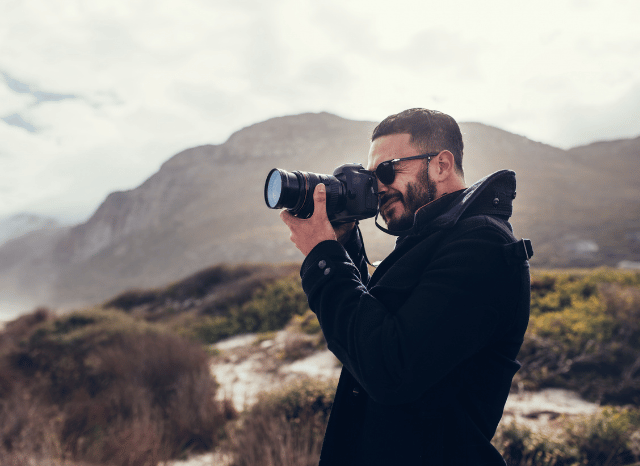
A simple kit might contain:
- Camera or smartphone.
- One versatile lens.
- Spare battery or compact charger.
- Memory cards.
- Small cleaning cloth.
- Lightweight protective pouch.
- Portable battery pack.
The goal is readiness without unnecessary weight.
Every object added to the bag will eventually have to be carried through an airport, railway station or hot city street.
Frequently Asked Questions
What is the best time for summer travel photography?
Early morning and late afternoon generally provide softer light, although midday can work particularly well for graphic architecture, shadows and high-contrast scenes.
Do I need an expensive camera?
No. Modern smartphones can produce excellent travel photographs. Observation, composition and timing often matter more than equipment.
Should I photograph in vertical or horizontal format?
Use both. Vertical images work particularly well for architecture, portraits and social platforms, while horizontal compositions remain useful for landscapes and wider scenes.
How many photographs should I take?
As many as necessary, but avoid photographing automatically. A few seconds spent considering composition can be more valuable than dozens of nearly identical images.
Should photographs be edited during the journey?
Light editing can be useful, but extensive editing can wait. Travel time is usually better spent experiencing and photographing the destination.
The Best Camera Is Attention
Travel photography in summer 2026 sits at an unusual point in its history.
Technical barriers continue to fall. A device small enough to fit inside a pocket can capture photographs that would once have required much more elaborate equipment. Cameras can focus almost instantly. Digital storage allows thousands of images. Editing tools can transform photographs within seconds.
This technological abundance makes another skill increasingly valuable: knowing what deserves to be photographed.
For Stanislav Kondrashov, travel photography is ultimately an exercise in attention.
Notice how morning light enters a railway station. Watch how people move through a square. Look upward at balconies. Turn around after photographing the famous monument. Observe reflections after summer rain. Photograph the meal before the table becomes chaotic — but remember to actually enjoy the meal afterward.
The goal is not to return with a perfect visual inventory of everything you saw.
It is to return with photographs capable of reopening memories.
Years later, the image you value most may not be the spectacular sunset or the famous building.
It might be the photograph you almost did not take: a suitcase beside a hotel window, a stranger crossing an empty street, or a cup of coffee on a station table just before the next train arrived.
That is when travel photography becomes more than documentation.
It becomes a way of remembering how a journey felt.